Haipei Industry Co., Ltd.

What are the main differences between elliptical heads and Dished heads?
Upload Time:
Sep 29, 2023
Material:Carbon Steel;Stainless Steel; Aluminum; Exotic Alloys; Special Steel... Diameter: 89 mm - 13000 mm Thickness: 3-400mm Technology: 1.Cold & Hot forming ;2. Hot Pressed Hemispheres and Cold Formed Segmental Hemispheres; Test:UT,RT,MT,PT,ET
Elliptical heads and dished heads are both commonly used pressure vessel heads, and their main differences are as follows:
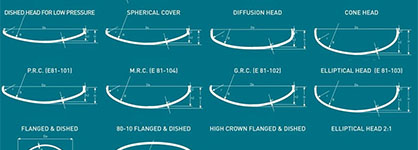
1. Shape and Structure: Elliptical heads are elliptical in shape with slightly tapered ends; while dished heads resemble the graph of a quadratic function, with both ends curving inwards into a cone shape. Therefore, dished heads are more aesthetically pleasing and have a greater three-dimensional appearance than elliptical heads.

2. Circumference: The contact line between an elliptical head and the vessel wall is an ellipse with a relatively fixed length. The contact line of a dished head is an arc with a relatively longer length. This means that for vessels of the same diameter, using dished heads can increase volume and improve vessel utilization.
3. Pressure Bearing Capacity: Due to the different geometry of dished heads compared to elliptical heads, under the same conditions, dished heads have higher rigidity, making them more suitable for bearing pressure. Furthermore, the pressure bearing capacity of dished heads can be further enhanced by increasing the cone angle. End Caps

4. Manufacturing Process: Elliptical end caps are simpler to manufacture than dished end caps, resulting in lower production costs. Dished end caps, on the other hand, require complex manufacturing processes such as CNC cold drawing, leading to higher production costs.
Elliptical and dished end caps each have their own characteristics. Designers should choose the appropriate end cap type based on specific usage requirements and budget. Elliptical end caps are suitable for containers with relatively low pressure, while dished end caps are suitable for containers with higher pressure and requiring increased volume. Of course, in practical applications, the choice of end cap also needs to consider specific design requirements, manufacturing difficulty, and material selection.
Relevant News
Contact Us
No.76,South.Road,Taishan Steel Market,Tai'an,Shandong Province


